Helping To Break the Stigma Surrounding Mental Health

Helping To Break the Stigma Surrounding Mental Health

Helping To Break the Stigma Surrounding Mental Health

Over the past eighteen months, through the work of the Mental Health Initiative, our community has been exposed to a diversity of facts, programs and marketing messages regarding the impact Mental Health has on our day-today lives. In recognition of May as Mental Health Awareness Month, it would seem wise to highlight some of the more significant issues affecting our emotional well-being.

  • 1 in 5 adults in the United States live with a mental health condition. * 60 million people in the United States face the day-to-day reality of living with a mental illness.
  • Half of all lifetime mental health conditions begin by age 14 and 75% by age 24, but early intervention programs can help. Yet only 50.6% of children with a mental health condition aged 8-15 receive mental health services.
  • 90% of those who die by suicide have an underlying mental illness. Suicide is the 10th leading cause of death in the United States, but suicide is preventable.
  • In North Carolina, suicide rates for youth 10-17 have doubled in the last 10 years and is now the 2nd leading cause of death for that age group, second only to auto accidents.
  • The best treatments for serious mental illnesses today are highly effective; between 70 and 90% of individuals have significant reduction of symptoms and improved quality of life with the right treatments and supports.
  • 56% of American adults with a mental illness do not receive treatment.

With the prevalence of mental health issues growing so significantly, the reality is that almost everyone in today’s society is impacted by knowing someone; a family member, friend, co-worker or neighbor who is struggling with a mental health issue. Why then are we still challenged with the “stigma” of seeking mental health counseling? For so many, there is still the long-term belief that seeking treatment for a mental health issue is a weakness.

If as individuals we acknowledge that mental health is affecting our lives; and if as a friend or loved one we recognize that accessing treatment can help those that we care about; then as a community it is critical that we collectively work to change the culture of how we perceive mental health. Just as we don’t think twice about seeking treatment for diabetes or taking medication for high blood pressure or getting physical therapy for a torn knee, so should we just as easily seek treatment for depression, anxiety, or any other issue that is impairing our emotional health and well-being.

As we look to raise awareness regarding Mental Health let us all promote good emotional health and recognize that accessing treatment is a strength, not a weakness. Personally, take the step to reach out to a family member, friend or co-worker that is struggling. Talk to them, encourage them to seek the treatment they need and support them in taking a positive step towards healing an emotional wound. If you are interested in helping to break the stigma around Mental Health or you want to learn more about accessing treatment, contact Jewish Family Services at 704-364-6594.

Jewish Family Services to Host Live Laugh Give Comedy Night Again This Year

Jewish Family Services to Host Live Laugh Give Comedy Night Again This Year

Jewish Family Services to Host Live Laugh Give Comedy Night Again This Year

What do you get when you combine a funny Jewish comedian and a great show with a VIP experience, live auction, and raffle prizes? Jewish Family Services’ Live Laugh Give Comedy Night. When asked what inspired JFS to start this event, Howard Olshansky, JFS Executive Director responded, “There are three things that bring people together for a good cause: laughter, prizes, and good food. We happen to have all three at our event.”

This year’s event will be held on Sunday, June 2 at Temple Beth El. The headliner for the evening is comedian Orny Adams, best known for his abundant energy, his many appearances on late night television and his role as Coach Bobby Finstock on the TV show Teen Wolf. After last year’s success, returning co-chairs, Suzy Catennazo and Andrea Cronson weigh in about last year’s fundraiser.

JFS: Tell me about your experience with the Live Laugh Give Comedy Night.

Suzy Catenazzo: Our goal is to provide a unique opportunity for entertainment while supporting a great cause. The entire event, from the food and drinks at the cocktail reception to the hilarious comedy show was so much fun. My favorite part was watching a packed house of people all coming together and laughing together.

Andrea Cronson: Laughing helps when times are rough. I think comedy is a good pairing for our fundraiser. Comedians make jokes about us, so we can laugh at ourselves and feel good doing it.

JFS: Why do you feel supporting the Live Laugh Give Comedy Night is important?

Suzy Catenazzo: I got involved with JFS because I believe they play such an important role. They provides social services that are easily accessible, serving people of all ages. This event, especially with the auction and call to the heart gave people the opportunity to show how important JFS is to this them.

Andrea Cronson: I think we all want to help our fellow human beings. We all run into difficulties from time to time and it’s important to have a safety net and that’s what JFS is, a safety net to so many people.

One of the many highlights of the event was the auction. With only three items to bid on the bidding was competitive.

Royal Hideaway Playacar and Mann Travels offered a threenight four-day stay at a five-star resort in the Riviera Maya. Wendy and Adam Petricoff won.

JFS: Tell us about the trip.

Wendy Petricoff: My husband bought the trip, not only to get away but because he knows JFS is my favorite charity. I just love the way JFS supports the community. The trip was so relaxing. The property was beautiful and our room was top notch; beautifully appointed.

Snap Av donated a SunBrite 43” 4K UHD Outdoor TV with an all-weather soundbar. Joel Pace won.

JFS: Tell us about your winnings.

Joel Pace: I was determined to win this prize. It’s great. Works beautifully. The event was amazing. From the time you got there until the time you left everything was great.

The Eat-Play-Stay Uptown: The Ritz Carlton, Blumenthal Theatre of Performing Arts, and Ciderworks.

JFS: Tell us about your experience.

Mason Sklut: We went with the some friends on the tour of the Cider Brewery and had a really nice time. It had that brewery vibe; open, rustic, lots of board games. It was interesting to see how the cider is made. The Book of Mormon was hilarious and had us in tears. We are looking forward to getting some R&R at our upcoming stay at the Ritz.

According to JFS Development Manager Susan Meyer, the committee has been working diligently and putting the final touches on this year’s auction items. “There was so much enthusiasm generated around stepping up packages we even added one more,” Meyer said. “We can’t wait to see how our guests respond.” This year’s items include a Comedy Zone Golden Ticket Package, a stay at the Kiawah Island Golf Resort, a one-year membership to Scout and Cellar wine club, and through Mann Travels, a vacation at Royal Hideaway Playacar in Riviera Maya.

Tickets are on sale now for the Live Laugh Give Comedy Night, benefitting Jewish Family Services. To select which experience you would like and pre-purchase raffle tickets, go to jfscharlotte. org.


JFS Marks a Year of Enhancing Programing for Holocaust Survivors

JFS Marks a Year of Enhancing Programing for Holocaust Survivors

JFS Marks a Year of Enhancing Programing for Holocaust Survivors

As an Executive Director, on any given day you can be in receipt of notification about a grant opportunity. The majority you rule out for some reason. But according to Howard Olshansky, Executive Director of Jewish Family Services, “This one completely grabbed my interest.” 

As an Executive Director, on any given day you can be in receipt of notification about a grant opportunity. The majority you rule out for some reason. But according to Howard Olshansky, Executive Director of Jewish Family Services, “This one completely grabbed my interest.” It was from the Jewish Federations of North America’s Center for Advancing Holocaust survivor Care and was all about enhancing the quality of life for a community’s Holocaust Survivor population utilizing a trauma-based approach. “I had only been with JFS about a year but one of the things that struck me was the gap in resources available to engage individually with our community’s survivors and enhance their connection to the community and with each other.”

This month will be a year since JFS was awarded a substantial grant from JFNA with three primary focus areas:

  • Enhancing the engagement of our community’s Holocaust survivors with the community and increasing socialization opportunities especially with each other.
  • Recognizing the trauma that a survivor of the Holocaust has experienced and lived with and creating every opportunity possible for any survivor in our community to leave their legacy by documenting their testimony in a sensitive, supportive environment.
  • Providing programming and support that recognize the challenges faced by children and caregivers of Holocaust survivors.

Over the past year, spearheaded by Sheryl Gerrard and Dana Kapustin, who work in JFS’ Department for Senior Engagement services, JFS has been overwhelmed at the level of interest and engagement from our community’s survivors. Through JFS’ outreach efforts, along with support from our community partners, JFS has been able to identify and engage 30 survivors in our community, some that we didn’t even know were living here, increase the participation of our survivors in community programs and, most significantly, hear and learn about their life experiences before, during, and since the Holocaust.

  • Results of the funding from this grant include the highest level of participation from our survivor community ever in our community’s Yom HaShoah and Kristallnacht commemoration programs.
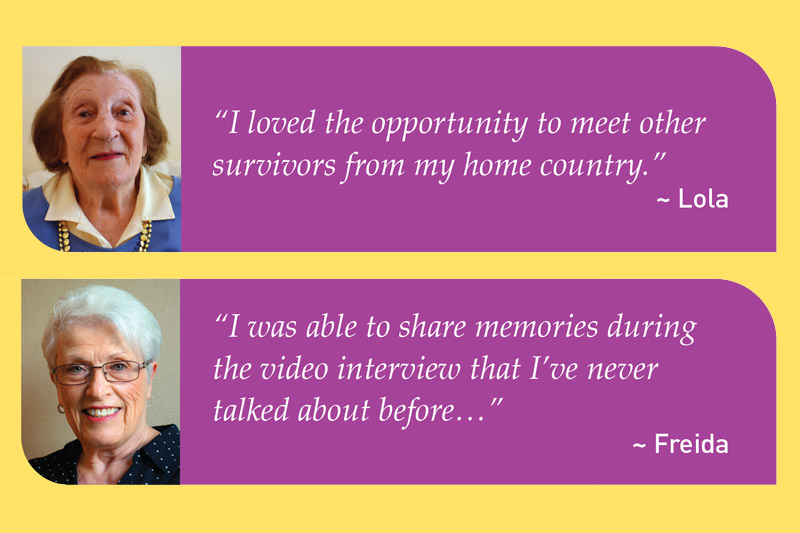
  • Our community’s Holocaust survivors have had multiple opportunities over this year to meet and socialize with each other including survivors in our community being introduced to other that were from the same country and even local towns whom they had never met.
  • Caregivers of survivors have had an opportunity to connect, commiserate, and learn from each other.
  • Seventeen of our community’s survivors were interviewed and had their testimonies video-taped. Some acknowledged that this was the first time they had actually told anyone of their survival experiences.
  • For the first time, survivors in our community participated in an Ethical Wills workshop, facilitated by Rabbi Judy Schindler, in which they were given the opportunity to put in writing a “legacy letter,” a gift, of their thoughts that they want to leave to future generations

The response from our survivor community to the events of the past grant year have been overwhelmingly positive. Comments such as “I appreciate being connected to this community since I’ve been so lonely” and “You’ve done a great job in recognizing us and helping us feel heard,” support the mission of the grant. For example, at the dinner prior to the Kristallnacht program, families were seated by country of origin. At a table for Russian- speaking individuals, one couple who recently moved here from Cleveland, were introduced to Marina, one of our survivors, who also lives here but had lived in Cleveland many years ago. As they explored their histories they realized that Marina was actually good friends with a relative of theirs. Small world! Marina had previously expressed feeling isolated and sad that she did not have many Russian speaking contacts.

As this article is being written, JFS was pleased to learn that we have been awarded a 2nd year grant to continue this work. We are excited to have the unique opportunity to expand social opportunities, enhance our engagement with our caregivers and continue to provide opportunities for survivors in our community to document their legacies.

Nutrition, Mental Health, and Mindfulness

Nutrition, Mental Health, and Mindfulness

Nutrition, Mental Health, and Mindfulness

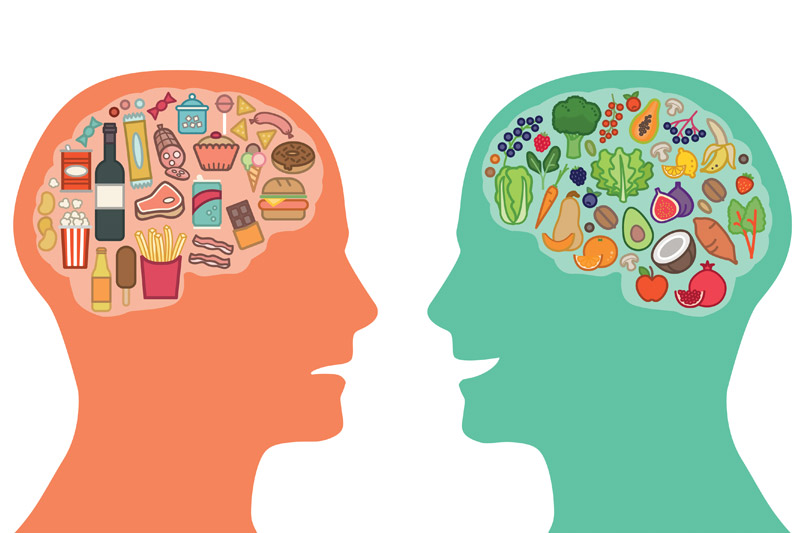
“What’s for dinner?” Did you know the nutritional quality of the food you consume can impact your mental health? In fact, there is a known correlation between a person’s diet and the part of the brain responsible for emotion, memory and motivation.

By Claire Alessi

Those who eat more nutritious foods demonstrate better emotional responses and improved memory, which can also stave off Alzheimer’s Disease and Dementia. And, if you are one of those people who enjoy eating a diet rich in “whole foods” such as fruits, vegetables, nuts, whole grains, legumes, fish, and unsaturated fats, you are up to 35% less likely to develop depression than those who eat less of those foods. Conversely, research also shows that regularly eating processed foods can increase your risk of developing depression as much as 65% and depression has been identified as one of the top five leading causes of disabilities. Nutrients that may play a role in combating depression include:

  • Vitamin B-12 and folate. Good sources of B-12 are salmon and trout. Folate is found in dark leafy vegetables, almonds, dairy and fortified whole-grain breakfast cereals.
  • Omega-3 fatty acids. The best sources of omega-3 fatty acids are fatty fish like salmon, catfish and trout. Other sources include ground flaxseeds, walnuts and omega-3 fortified eggs.

And, it is not only beneficial to observe what’s for dinner, but how you eat your dinner. The term mindfulness, “the practice of being aware of your body, mind, and feelings in the present moment, thought to create a feeling of calm”, has been gaining in popularity the last number of years. Having a mindfulness routine has been identified as a key practice to alleviating mental illness symptoms.

So what does mindful eating look like? In a very basic sense, mindful eating means eating slowly while noticing all the different sensory aspects of food such as taste, texture and aroma. Practicing mindfulness has proven to decrease stress and increase enjoyment. So it seems eating more nutritiously and mindfully, has its benefits. Here’s an exercise you can try to eat more mindfully – Eating an Orange Mindfully. Find a quiet space with limited distractions before beginning this exercise.

  1. 1Hold the orange in your hand and examine it. Look at the orange as if you have never seen an orange before—engaging the five senses as you eat the orange.
  2. Next, put the orange up to your nose and smell the aroma of the orange. Feel the texture of the orange peel.
  3. As you begin to peel the orange, notice the sound it makes as you peel it. Observe the aroma and how it continues to grow as you continue to peel it.
  4. Look closely at the peeled orange and notice the different colors and textures between the sections of orange and its white fibers.
  5. Pull apart the sections and gently place the orange in your mouth, letting it lie on your tongue first without taking a bite. Observe what you taste, feel, and recognize.
  6. Bite down on the orange and notice the flavor. Begin chewing and observe how the texture and consistency of the orange changes as you continue to chew.
  7. When ready, swallow the orange and be conscious of the act of swallowing. Attempt to observe this action as the orange moves down your throat to your stomach.
  8. Take time after this exercise to reflect on your experience and observations.

Healthy vs. Unhealthy Teen Relationships

Healthy vs. Unhealthy Teen Relationships

Healthy vs. Unhealthy Teen Relationships

Know the Difference and How To Protect Your Teen

As parents, from the time our children are infants, we strive to do everything we can to protect them from being hurt, both physically and emotionally. We do our best to make sure they go to the finest schools, know how to select the right friends, and teach them to stay away from negative influences.

 And yet, in our society, impacting all socioeconomic groups, according to the National Council On Crime and Delinquency, one in three girls in the US will be a victim of physical, emotional, or verbal abuse from a dating partner and 1.5 million high school students will experience abuse from a dating partner in a single year. One quarter of the abuse was first experienced between the ages of 11 and 17 years. Many of these youth fear reporting the abuse, so the number of abuse incidents is likely much higher than documented. And sadly, it does not end in high school. Nearly half of all dating college women report experiences of violent and abusive dating behavior. 

Unfortunately, while the data demonstrates the enormity of the issue, there is a lack of awareness regarding the prevalence of teen dating violence. Only 33% of teens who were involved in an abusive relationship told anyone and equally significant and surprising is the fact that 81% of parents do not believe teen dating violence is an issue. Most parents assume their children are not at risk. Hopefully, your teen knows and understands healthy relationships and won’t need to work through an unhealthy relationship. Sometimes everything starts out great but slowly changes into a less healthy dynamic. Healthy and unhealthy relationships may not be clear cut. It is not uncommon for teens to get pulled into unhealthy relationships during their youth, which is a time when they’re trying to figure themselves and their peers out. 

One of our greatest challenges is helping to protect our children when they don’t want it or think they don’t need it. As teens, our kids believe they are capable of handling any situation that comes their way, especially with their friends, peers, and dating relationships. Parents often feel they are bystanders as teens are often seen as only being influenced by their peers and social media. Yet teens consistently say that parents – not partners, not pop culture – most influence their decisions about relationships and sex.

So, as a parent, what should you do?

If you are ever worried about relationship dynamics that you see going on for your teen, we offer the following tips for helping to keep you teen safe from dating violence:

  • It’s never too early to teach your child acceptable behaviors in a relationship. Create an environment that makes it comfortable to share their feelings and experiences
  • Understand what constitutes an abusive relationship, it’s not just about physical violence: Yelling, bullying, constantly being put down, controlling behaviors, inappropriate postings on social media are all types of abuse.
  • Check in regularly with your teen about their dating experiences. They may be resistant to sharing, however, helping them to understand that you are truly interested and just not prying will help open the dialogue.
  • Share your experiences, the good and the bad.
  • Plan an activity where you can meet your teen’s partner.
  • Monitor your teen’s behavior for warning signs: A decline in school performance and other activities, changes in personality, changes in eating or sleeping habits, signs of depression or anxiety, increased secretiveness, use of drugs or alcohol, obsession with dating partner, physical signs of abuse such as bruises, scratches, or other injuries. 

February is Teen Dating Violence Awareness Month, a great time to talk about healthy and unhealthy relationships. Keep an open mind as teens mostly fear being blamed for the abuse. Let your teen know you care and are available if they are ever feeling uncomfortable in a relationship. 

Join us for Dating Abuse; Tools for Talking to Teens on February 20 from 6:30–8 PM in the Teen Meeting Room in Shalom Park. For more information or to RSVP to this program, call Jewish Family Services at 704- 364-6594.